

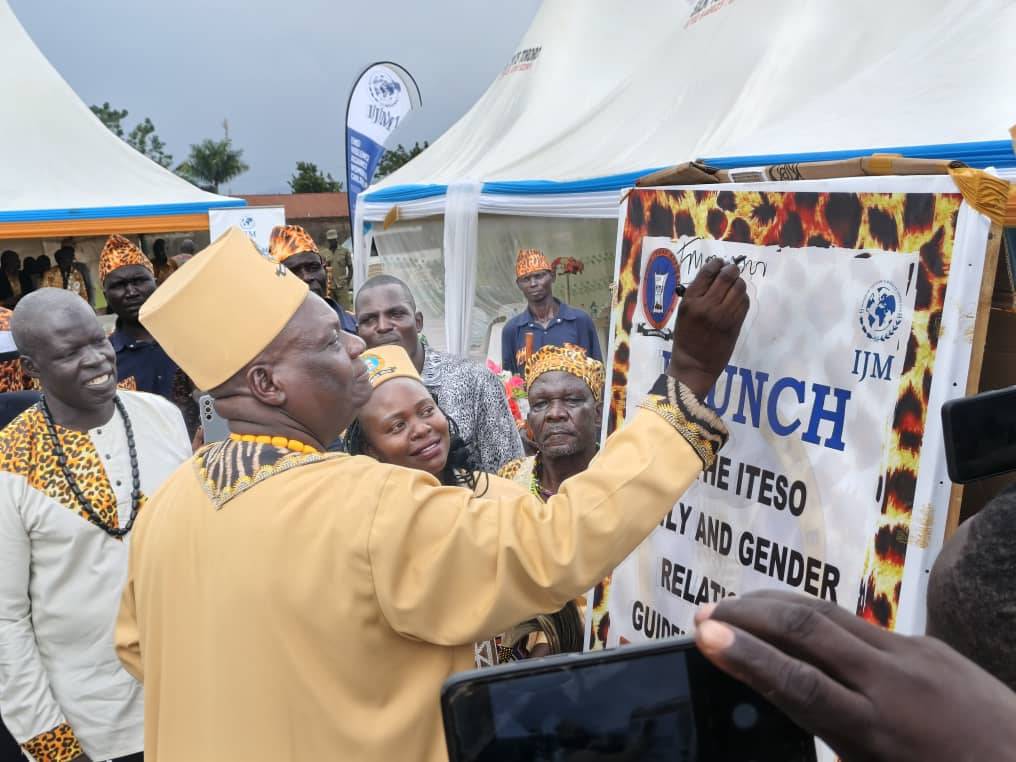
The Iteso Cultural Union has launched new Family and Gender Relations Guidelines aimed at addressing harmful cultural norms and practices that fuel violence in homes and communities, in a move supported by International Justice Mission.
The guidelines were launched with support from the International Justice Mission to provide direction on handling family and gender-related disputes within communities. The handbook emphasizes that serious criminal offences such as domestic violence, sexual assault, defilement and child marriage must be reported to the formal criminal justice system, while minor family disputes may be mediated through clan leadership structures.
The initiative marks the third cultural institution supported by IJM to develop context-specific protection guidelines, following Ker Kwaro Acholi in 2023 and Obusinga Bwa Rwenzururu in 2024. The effort is part of broader interventions aimed at strengthening traditional and community-based protection mechanisms against violence.
Speaking during the launch, His Royal Highness Emorimor Papa Paul Sande, accompanied by Her Majesty Juliet Among Emolot, strongly condemned gender-based violence.
“GBV must stop and has no place in this generation. We want peace in our homes,” the Emorimor said.
He added that the newly launched guidelines would strengthen collaboration between cultural institutions, local governments and the justice system in addressing violence within communities.
IJM Country Director Wamaitha Kimani commended the cultural institution for taking a leadership role in protecting vulnerable groups, especially women and children.
“The Guidelines affirm culture as a powerful force for good, one that protects dignity of vulnerable women and children, upholds justice, and promotes peaceful coexistence in homes,” Kimani said.
She further welcomed the recognition within the guidelines that serious offences such as defilement, child marriage and gender-based violence should be formally reported to law enforcement authorities.
The event also featured performances by survivor leaders from the Uganda Survivor Network, who staged a skit depicting how violence manifests within families and communities. The performers urged local leaders and communities to support survivors in reporting cases to police and seeking justice.
Several leaders from across the region attended the event, including Julius Oketcho, Bernard Ochieng, and representatives from cultural institutions such as Ker Kwaro Acholi, Tieng Adhola, Samia and Bugisu cultural leadership structures.
The launch is expected to strengthen collaboration between cultural institutions and formal justice systems in the fight against gender-based violence and the protection of vulnerable members of society.
